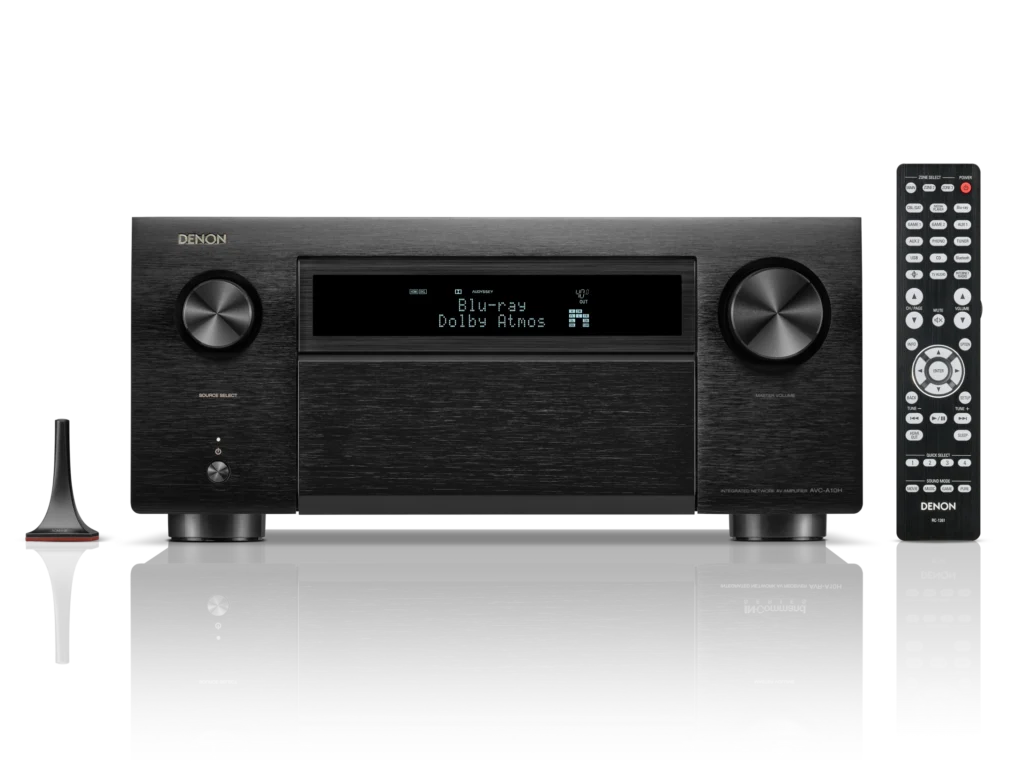
The Denon AVC-A10H targets an ambitious cinema system that needs more than eleven powered channels but does not require the A1H’s fifteen. It combines thirteen internal amplifiers with substantial construction and flexible calibration options. Its strongest argument is a complete high-channel-count system in one chassis, provided the room and speaker budget justify the step beyond more affordable models.
Denon AVC-A10H — Thirteen channels without extra amplifier boxes
Denon’s European information specifies thirteen internal power-amplifier channels and 13.4-channel processing. Logical maximum layouts include seven bed speakers with six heights or nine bed speakers with four heights, plus suitable powered subwoofers. The correct arrangement depends on the room, seating and available placement, not simply a preference for the largest printed number.
Four subwoofer connections provide line-level feeds. They do not add four powered speaker channels or imply that every installation needs four subwoofers. Their practical value is placement and integration flexibility, particularly when more than one seat needs consistent bass coverage.
The published 150-watt rating is into eight ohms across the audio band with two channels driven. It should not be multiplied by thirteen and described as a measured simultaneous output. Loudspeaker sensitivity, distance and low-frequency routing have a more useful role in evaluating the required headroom.
The A10H is especially relevant when a nine- or eleven-channel amplifier would need another power-amplifier box to complete the planned layout. Compare the total system cost, cabling and furniture space. If suitable external amplifiers are already owned, a lower-tier processing-capable alternative may remain the more economical choice.
Sound quality and the premium proposition
StereoNET’s original review praises the A10H’s clarity, dynamic contrasts and surround steering, and finds it close to the A1H in its own system. That is strong evidence for its position as a premium cinema amplifier, while the comparison remains specific to the reviewer’s room, speakers and setup.
The interesting question for a buyer is whether the premium produces useful control at the intended listening level. A sudden action sequence can be impressive, but the system should also keep dialogue and quieter effects coherent without constant adjustment. A flagship demonstration played louder than a competing amplifier is not a controlled comparison.
The A10H’s physical and power-supply construction is part of its higher-tier design. Those engineering choices deserve attention without turning a list of components into an automatic listening verdict. A well-matched complete system remains more important than assuming a heavier transformer guarantees the preferred tonal balance.
For music, compare stereo, multichannel material and upmixed playback separately. The available speakers offer several presentation choices, but the original mix should remain a reference. If stereo music is a major part of the routine, include it in the audition rather than extrapolating everything from movie effects.
Room correction and subwoofer integration
Audyssey MultEQ XT32 is included. Use its supplied measurement process carefully, with the microphone in representative positions and the room quiet. Check crossovers, speaker assignments and levels after calibration. An automatic setup result is a useful starting point rather than permission to ignore the configuration.
Dirac’s official compatibility announcement includes the European AVC-A10H for optional ART support alongside the wider Dirac upgrade path. This is licensed functionality, and the intended Room Correction, Bass Control and ART package should be priced as part of the complete system. Confirm firmware and measurement-equipment requirements before committing.
A buyer does not need to purchase every software option immediately. First establish sensible speaker and subwoofer positions, then identify any remaining integration objective. A processing upgrade is most useful when it addresses a specific problem rather than simply making the ownership checklist longer.
Large speaker systems also benefit from careful physical verification. Label the leads, confirm each channel with a test signal and make sure the height and surround assignments match the room. No correction package can make a wrongly connected speaker behave as though it were installed in the intended position.
Keep saved settings and compare changes at similar playback levels. A new target with more bass can initially sound larger without improving consistency or dialogue. The aim is a system that works across real content and seats, not only a dramatic before-and-after demonstration.
HDMI, sources and daily operation
The A10H provides seven HDMI inputs and three outputs, with support for modern 4K/120 Hz and 8K/60 Hz paths through compatible equipment. eARC supports television-return audio, while direct HDMI source connections give another route for disc players and consoles. Those paths should be planned according to the actual source and display requirements.
For gaming, confirm resolution, refresh rate, HDR and variable-refresh operation together. A successful picture at one format does not prove every higher-bandwidth combination is available. Cable suitability and the selected input mode on the display can be as important as the amplifier’s headline specification.
Multiple display outputs require a check of the manual’s assignment and format rules. Do not assume that every connected television and projector can receive unrelated formats independently. This is especially important when one display has lower capabilities and the cabling will be difficult to change after installation.
HEOS and AirPlay 2 add convenient music playback, with analogue and digital inputs for other components. A moving-magnet phono input supports an appropriate turntable. The European AVC version should be selected for the intended mains and support arrangements rather than treating an overseas AVR listing as automatically identical in every regional facility.
Installation and value
Denon lists a weight of approximately 23.6 kg and a substantial chassis depth. Check the supporting shelf, ventilation and rear-cable clearance before ordering. A component can fit the visible opening of a cabinet while leaving too little room for connected plugs or warm air to escape.
The traditional Denon front panel is functional rather than radically styled. That can be an advantage in a dark cinema where readable information and straightforward operation matter more than decorative features. The real test is whether the system remains easy for everyone in the household to start, select and shut down reliably.
The A10H’s value is strongest against the A1H when thirteen powered channels are enough. Paying for two unused channels is difficult to justify if the difference could improve the centre speaker, subwoofers or acoustic treatment. Equally, the step above an eleven-channel amplifier makes sense only if the room can use the extra layout options or the broader premium package.
Compare current European offers with authorised warranty and the chosen software included. Launch prices and isolated foreign discounts do not describe the complete local purchase. A high-end cinema amplifier is most convincing when it fits a balanced system plan, with installation and calibration funded alongside the hardware.
For a dedicated room or a carefully designed large lounge, the A10H can simplify a complex system without requiring the absolute flagship. For an ordinary five-speaker setup, its capacity is excessive. The recommendation follows the planned installation rather than the assumption that a higher product tier is always the safest choice.
Alternatives to consider
Anthem MRX 740 8K: Compare a different calibration and amplification approach, including every external channel needed for the intended layout.
Marantz CINEMA 50: A smaller-channel starting point if the room does not need the A10H’s thirteen internal amplifiers.
Denon AVC-X3800H: Useful for testing whether the actual room and source requirements can be served at a much lower total hardware cost.
Denon AVC-A10H key specifications
- Powered speaker channels
- 13
- Processing
- 13.4 channels
- Example layouts
- 7.4.6 or 9.4.4 with appropriate powered subwoofers
- Rated output
- 150 W/ch, 8 ohms, 20 Hz–20 kHz, 0.05% THD, two channels
- HDMI
- 7 inputs / 3 outputs; eARC
- Calibration
- Audyssey MultEQ XT32; optional licensed Dirac facilities
- Weight
- Approximately 23.6 kg
- Region
- EU AVC version
Verdict
The AVC-A10H is a strong premium cinema choice when thirteen internal channels are the right fit. Independent evidence supports its clarity and dynamic control, while current calibration options provide a serious development path. Its cost and installation needs demand a real room plan, and its value is best judged against complete alternatives rather than a headline channel count.
Primary documentation and independent reviews
Denon AVC-A10H official specifications · Denon official European A10H information sheet · Dirac official ART compatibility announcement · StereoNET original AVC-A10H review
Editorial record
Sources and updates
Product specifications and factual claims were checked against Official Denon AVC-A10H product page ↗. Scores and buying advice follow our category-specific editorial methodology.
- Published
- November 7, 2026
- Last updated
- November 8, 2026