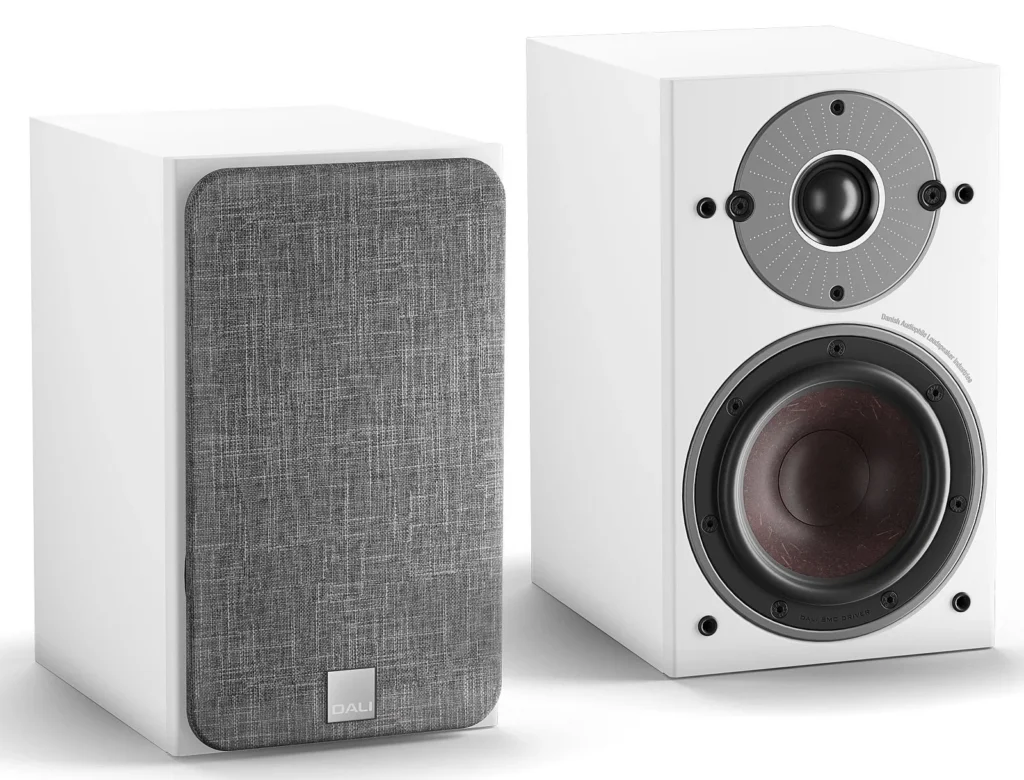
DALI OBERON 1 C takes the compact bookshelf-speaker format and combines it with internal amplification and a wireless signal from a separate DALI hub. It is not the passive OBERON 1, nor is it a self-contained Bluetooth speaker that needs no other component. The hub determines the source connections and much of the streaming capability. Original listening evidence is positive about clarity and musical engagement, with a clear qualification about bass depth and authority in larger spaces.
Research-based review. This assessment draws on manufacturer documentation and the original published evaluations linked below. Audio Review has not performed a hands-on test of this model.
The hub is part of the system, not an optional detail
The active speakers work with a compatible DALI Sound Hub or Sound Hub Compact. They still need mains power at each cabinet. The wireless link removes the normal speaker-level signal cables from a separate amplifier, not every cable in the installation.
Check what is actually included in an offer. A speaker-only used listing and a complete hub package are different purchases. Ask the seller to demonstrate both channels with the intended hub before deciding that a low cabinet price is a bargain. Plan where the hub, source leads and power supplies will sit. This architecture can keep source cables away from the speakers and make placement tidy, but it still benefits from a clear system plan rather than the expectation that unpacking two cabinets is the entire setup.
Two hub approaches answer different needs
What Hi-Fi’s original evaluation distinguishes the compact television-oriented hub from the full Sound Hub with its streaming-module route. Current hub specifications and the exact supplied version should be checked separately from an older review. Network functions are not inherent in the OBERON speaker cabinets themselves.
List the essential tasks: television sound, Bluetooth playback, a disc player or direct network services. Confirm the included module if streaming is central. A hub with the right inputs may remove the need for another box, while the wrong version can make the complete purchase less convenient than an integrated rival. Do not assume a USB port means general music playback or that a product-family name guarantees every expansion. The purpose of the modular approach is a useful choice, provided the chosen parts actually deliver the intended routine.
Clear midrange and musical engagement
The original What Hi-Fi test praises vocal clarity, organisation, agility and an engaging sense of music. It also hears less bass depth and authority than larger speakers can provide. That combination makes a credible case for a compact room rather than a claim that cabinet size has ceased to matter.
Audition with a natural voice, a dense arrangement and a familiar bass line. Listen at the distance and level expected at home. A small speaker can offer an appealingly coherent presentation without filling a large room effortlessly. Decide whether the clarity and scale suit the actual music and television use. If deep bass is a priority, compare the complete cost and placement of a suitable subwoofer arrangement or a larger speaker system before assuming that extra amplification inside the cabinet resolves the requirement.
Placement should suit both sound and daily use
DALI allows several installation approaches, including stands, a shelf and appropriate wall mounting. The original reviewer finds useful results near a wall while preferring some space in the tested room. That is a starting point for experimentation, not a universal distance to reproduce in every home.
Keep the two cabinets in positions that create a sensible stereo layout and leave room for safe power routing. If using furniture, check stability and unwanted vibration. If wall mounting, use the correct fittings and support for the actual wall and speaker. Try a few positions before changing supporting equipment. A compact active pair can be easier to accommodate than larger floorstanders, but its main advantage is being installable where it will actually be listened to comfortably. Hiding one speaker behind a screen defeats that benefit.
Television convenience requires a real demonstration
The Sound Hub Compact offers a television connection and control-oriented functions, while the exact HDMI specification and behaviour depend on the supplied hub version and current documentation. The original review’s successful experience should not be promoted into a guarantee for every television and application.
Test ordinary volume control, standby return, input changes and lip synchronisation with the actual TV. Check the required audio format and cable arrangement in the applicable manual. A clear two-speaker stereo image can be a compelling alternative to a single soundbar for some rooms. It is still a stereo purchase unless a specifically supported larger DALI system is assembled. Avoid assuming that buying this pair automatically provides every surround function associated with the wider ecosystem or with an optional hub expansion.
Legacy status and the complete value calculation
DALI lists the OBERON 1 C in its discontinued range. That does not make a functioning pair unusable, but it changes the buying questions. The condition of the speakers, hub, remote, power equipment and current support all deserve attention.
Compare with newer active systems at today’s complete prices. Include stands, the necessary hub and any network module, then decide whether the DALI architecture remains appealing. For used equipment, demonstrate wireless linking and all inputs that will be needed. Confirm that any missing accessories can be replaced sensibly. A legacy system can be good value when the package is complete and the performance suits the room. It is less attractive when a bargain speaker listing turns into a hunt for the controller or module that was assumed to be included.
Alternatives to consider
KEF LS50 Wireless II: LS50 Wireless II is a relevant active-system comparison with a different source and control arrangement. Compare the whole price, including the DALI hub and any required streaming module, rather than speaker-only offers.
KEF LSX II: LSX II offers another compact integrated approach. Try both in the intended room and compare the control experience, bass expectations and complete footprint including stands or furniture.
DALI OBERON 1 C key specifications
- Type
- Active wireless bookshelf stereo speakers
- Bass / mid driver
- 5¼-inch wood-fibre composite
- Tweeter
- 29 mm soft dome
- Amplification per speaker
- Two 50 W peak Class D channels
- Signal source
- Compatible DALI Sound Hub or Sound Hub Compact
- Speaker power
- Mains required at each cabinet
- Source inputs
- Located on the selected hub
- TV connection
- Hub-dependent HDMI or optical arrangement
- Network streaming
- Depends on selected hub and compatible module
- Standalone Bluetooth speaker
- No; source connection is through the hub
- Placement
- Stand, shelf or appropriate wall mounting
- Dimensions (W × H × D)
- 162 × 274 × 234 mm per speaker
Verdict
OBERON 1 C is an appealing compact active pair with strong original evidence for clarity and musical engagement. Its separate-hub architecture can make a tidy, flexible stereo installation when the chosen package matches the owner’s sources.
Verify the hub and modules, plan mains power for both speakers and keep bass and room-scale expectations realistic. Compare the full current package with integrated KEF alternatives and account for legacy-product support. Chosen on that complete basis, the DALI can remain a satisfying system rather than merely an attractive pair of small cabinets.
Documentation and original reviews
DALI official OBERON 1 C product information in its discontinued range · DALI official Sound Hub Compact source connections and system role · What Hi-Fi original OBERON 1 C evaluation with both hub approaches
Editorial record
Sources and updates
Product specifications and factual claims were checked against Official DALI OBERON 1 C product page ↗. Scores and buying advice follow our category-specific editorial methodology.
- Published
- November 17, 2026
- Last updated
- November 17, 2026