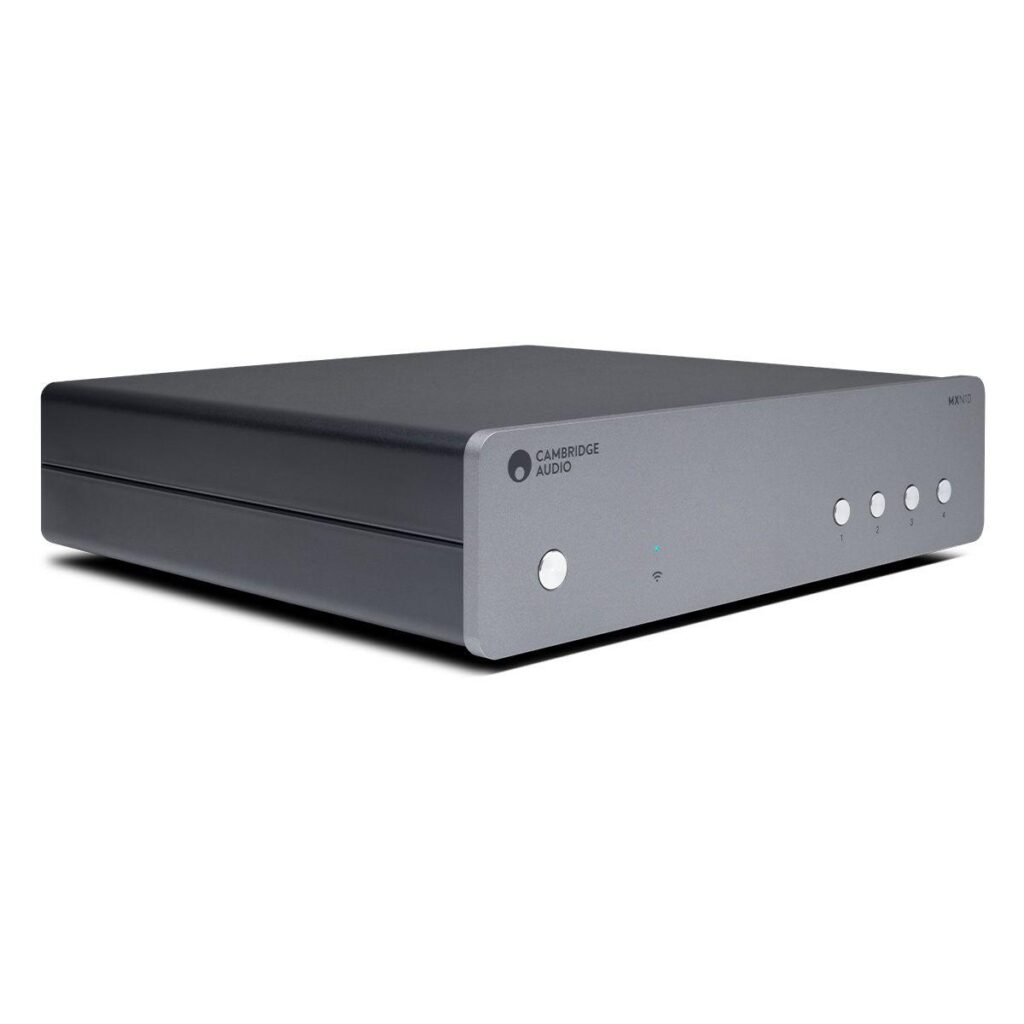
The Cambridge Audio MXN10 is a compact network player designed to sit beside an existing amplifier rather than replace it. Its combination of analogue output and two digital-output types makes it useful in several system arrangements. The buying decision should begin with the output and control method you need, not the largest sample-rate number in the specification.
Cambridge Audio MXN10 — Choose the role before choosing the cable
Cambridge documents an unbalanced analogue line output alongside coaxial and optical digital outputs. Use the analogue route into a suitable amplifier or powered-speaker line input when the internal DAC will do the conversion. Use a digital output when an existing compatible DAC or digital-input amplifier is the preferred destination.
These are output options, not speaker terminals. Passive loudspeakers still need amplification. A digital coaxial socket also should not be confused with an analogue RCA input merely because both use a similar connector shape. Match the signal type at both ends before buying adapters.
StreamMagic is central to everyday use
The StreamMagic platform and app are the practical centre of the MXN10. Cambridge describes playback from network sources, USB storage and compatible streaming services. Check the particular service, subscription and local availability used in the household rather than assuming every streaming route exposes the same features or resolution.
A successful first track is not the entire ownership test. Try browsing a large library, changing queues and moving between household control devices. If the device is for a family system, reliable app discovery and clear source selection can be more valuable than support for an exotic file type that is never used.
Do not confuse maximum decoding with every output
The official product information identifies an ESS Sabre ES9033Q DAC and high-resolution format support. A DAC chip name is not a sound-quality score, and the player’s maximum internal decoding capability should not be transferred to every output or casting method without checking the manual.
The receiving DAC also sets limits when using optical or coaxial output. Select compatible formats and verify stable lock. Very high sample rates do not improve an ordinary recording by themselves, and buying new hardware solely to display a larger number can leave the actual listening problem untouched.
Network planning and system value
Ethernet and wireless connection options make placement more flexible, while Bluetooth 5.0 offers another playback route. For a fixed installation, a dependable network path is more important than hiding every cable. Keep the player accessible enough to inspect connections and restart or service it when necessary.
The USB media connection should be distinguished from the servicing connection described in the manual. Do not assume every USB-shaped socket is an interchangeable audio input or output. Check the intended port and supported storage arrangement before building a local-library workflow.
The MXN10 makes the most sense when the existing amplifier and speakers are already satisfactory. Compare it with a simpler streaming adapter and with a larger player only where the extra controls or connections solve a specific need. We have not measured its analogue performance or compared its sound with another streamer, so those outcomes remain open.
What to expect in a real setup
Can MXN10 connect directly to passive speakers? No. It is a network source with line-level and digital outputs. Add an appropriate amplifier, or connect to powered speakers through a suitable line input.
Does a coaxial output connect to any RCA input? No. A digital coaxial output needs a compatible digital input. An ordinary analogue RCA input expects a different signal.
Where volume belongs in an MXN10 system
The MXN10 is a source component, so the complete system still needs suitable amplification and a clear way to set listening level. With a conventional integrated amplifier, keep the amplifier’s volume control as the normal point of adjustment and configure the source according to the operating instructions. Connecting a source to a power amplifier without checking level control is a different proposition from connecting it to a normal line input. Do not assume that app playback controls provide every preamplifier function required by a particular installation.
Its analogue and digital connections also represent different uses of the same purchase. Feeding an amplifier through analogue outputs uses the MXN10’s conversion stage. Feeding a separate DAC through a digital output uses it as a transport. The second route may be appropriate when the existing DAC provides the required switching or connections, but it leaves part of the streamer’s hardware redundant. Compare the complete arrangement with a simpler transport before paying for facilities that will not be used. Output compatibility is more relevant than the highest file specification printed elsewhere on the product page.
Test the library rather than a prepared playlist
For an owner with a substantial digital collection, a useful audition involves their own folders, metadata and usual method of browsing. Try a compilation, a multi-disc album and a release with similar artist names. Network storage permissions and inconsistent tags can cause frustration that has nothing to do with analogue sound quality. Keep original files backed up independently and avoid using a streamer-attached drive as the only copy of a collection.
Streaming-service use deserves an equally practical check. Confirm the required service, account tier and control route before purchase, then try finding saved favourites and returning to playback after standby. A compact component may sit neatly beside an existing amplifier, but reliable access and easy navigation determine whether that compactness is useful. The MXN10 is most convincing when it brings an older system into regular use without demanding a new control routine. If a buyer instead needs television switching, speaker amplification or an extensive analogue preamplifier, those requirements belong elsewhere in the system and should be included in the budget from the start.
Alternatives to consider
Cambridge Audio CXN100: Compare the larger Cambridge player when its display, controls or connection arrangement will genuinely be used.
WiiM Pro Plus: A relevant alternative streaming platform to investigate if the required input/output set or preferred app differs.
Cambridge Audio MXN10 key specifications
- Role
- Network music player
- Analogue output
- Unbalanced line output
- Digital outputs
- Coaxial and optical
- DAC
- ESS Sabre ES9033Q
- Platform
- StreamMagic
- Local playback
- USB storage and network/NAS sources
- Network
- Ethernet and Wi-Fi
- Bluetooth
- 5.0
- Speaker amplification
- None
Verdict
The MXN10 is a focused route into network playback for an established stereo. Its output flexibility and StreamMagic workflow are the reasons to consider it. Match the receiving equipment and audition the app experience before deciding that higher format limits or a named DAC chip justify the purchase.
Primary documentation
Specifications and feature descriptions were checked against the following official documents on 6 November 2026. Compatibility advice is our interpretation of those documented capabilities; it does not establish measured sound quality. Regional bundles, software features and service availability can change, so verify the exact European model and current support information before purchase.
Editorial record
Sources and updates
Product specifications and factual claims were checked against Official Cambridge Audio MXN10 product page ↗. Scores and buying advice follow our category-specific editorial methodology.
- Published
- November 7, 2026
- Last updated
- November 8, 2026