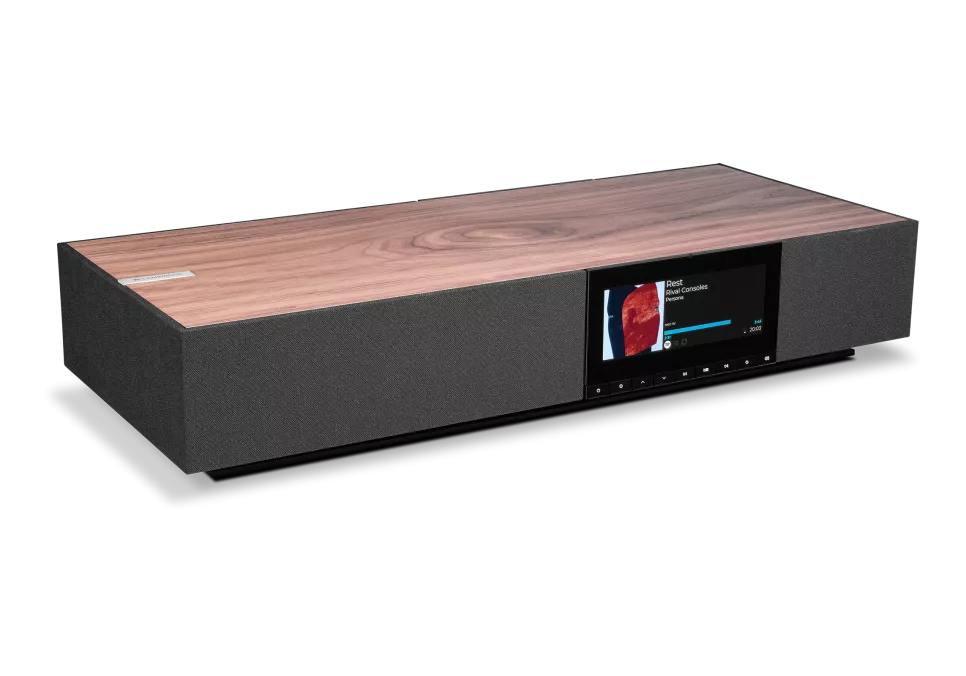
Cambridge Audio Evo One is a complete powered music system with speakers, amplification and streaming inside one substantial enclosure. It differs fundamentally from Evo 150: there is no need to add passive speakers, but the left and right sound sources cannot be spread around the room independently. MM phono and stereo television eARC extend its role beyond subscription music. This research-based review considers its broad source selection, documented room adjustments and original listening evidence, with practical attention to the size and one-box compromise behind its attractive appearance.
Research-based review. This assessment draws on manufacturer documentation and the original published evaluations linked below. Audio Review has not performed a hands-on test of this model.
Broad, composed sound rather than maximum rhythmic urgency
What Hi-Fi’s original evaluation finds a broad, consistent presentation with smooth dynamic changes and a controlled overall character. It also hears some disconnection in the lower frequencies and less punch and rhythmic assertiveness than favoured rivals. That gives a useful picture of priorities rather than a simple assumption that the large driver count makes every style of music equally convincing.
Audition familiar voice-led music, a rhythmically busy track and a larger-scale recording. Listen from the main seat, then move to other positions where people normally spend time. A shared living area may benefit more from consistent room coverage than from a narrowly defined stereo sweet spot. A listener who sits down specifically to follow instrumental interaction may prefer another balance. Judge bass cohesion and musical momentum over complete passages, not only the impression of size during a short demonstration. The published evidence supports a serious one-box shortlist, while leaving those particular aspects open to personal comparison in the actual room.
One enclosure is a deliberate stereo compromise
The Evo One integrates fourteen drivers and their amplification rather than providing separate speaker cabinets. Its documented array spreads sound around the enclosure, supporting a broad listening area. It remains a single physical object, without the independent left-right spacing available from a conventional stereo pair.
Choose it when reducing equipment and cabling is a real priority, rather than expecting it to reproduce every aspect of widely separated speakers. Assess whether the room is used for focused listening, background music across several seats or both. A complete one-box system may suit a shared space particularly well, while separate speakers can offer more freedom to establish an image around the main seat. Neither approach is automatically more appropriate for every home. Consider where the unit will actually sit, not just how attractive it looks in a photograph. Its sound paths should remain clear, and the furniture should support its substantial weight securely. The decision becomes easier when the intended listening pattern is settled before comparing specifications.
Room adjustments are useful manual tools
The official manual provides Speaker Placement adjustment for proximity to the nearest rear wall, Room Compensation for reflective or softer surroundings, user EQ and a Loudness option. These are useful setup controls, but they should not be described as an automatic microphone-based measurement and correction process.
Begin with sensible placement, then use the documented controls gradually. Replay the same familiar passage after each change and keep a reference setting available. A room with hard surfaces may need a different balance from one with curtains and soft furnishings, but the slider is not a substitute for listening. Avoid boosting several frequency bands before understanding what the default presentation does. Check ordinary quiet listening as well as the level used for a music session. Loudness can be useful for a particular routine, but it should be judged rather than left enabled because it sounds more impressive initially. Good adjustment should make voices and bass more coherent without turning every recording into the same exaggerated balance.
Streaming convenience belongs to everyday use
StreamMagic combines network control with established playback routes such as AirPlay 2, Google Cast and compatible connect services. Ethernet and Wi-Fi provide network options, while local media and Bluetooth cover other sources. Bluetooth uses SBC and AAC according to the official specification, rather than assuming the aptX facilities of another Evo product.
Try the intended accounts and household phones before deciding the platform is convenient. Check how playback starts, how another person takes over and how the unit returns from standby. A service logo does not mean a subscription is included, and different casting routes may have different format and control behaviour. An existing multiroom household should confirm actual grouping requirements rather than expecting every connected speaker to work together automatically. The remote and visible display can remain useful even when the app handles most browsing. A complete system earns its convenience case when those ordinary tasks remain simple months after installation. The broad source list is valuable when it reduces friction, rather than creating several competing routes that users cannot distinguish.
Phono and television sources need the correct signal
The analogue provision includes separate line-level and moving-magnet phono inputs. Optical and eARC/ARC are documented for PCM audio. That makes a stereo television role practical without implying Dolby Atmos or DTS decoding from the presence of an eARC socket.
Check whether a turntable already has an active phono stage before choosing its connection. Use the proper input for the signal, avoiding double phono amplification or an under-amplified cartridge route. A moving-coil setup may require a suitable separate stage. For television, select appropriate stereo PCM output and test internal apps and external devices separately. Check synchronisation, remote volume and return to music afterwards. A large all-in-one music system can improve everyday viewing while remaining a stereo device. If immersive film reproduction is the main objective, compare a documented cinema system instead of buying on a television-connection label alone. The Evo’s flexibility is strongest when both the record player and screen can join the music system without extra boxes or uncertain signal conversion.
Substantial furniture requirements and complete value
At approximately 675 mm wide, 129 mm high and 290 mm deep, and around 14.7 kg, Evo One is a substantial mains-powered component. It is not a portable Bluetooth speaker despite putting the system into one enclosure. Its depth and weight deserve as much attention as its front appearance.
Measure the furniture, rear connector clearance and screen sightline if it will sit beneath a television. Keep the unit secure and its sound paths unobstructed. Compare current complete prices with alternatives that may require separate speakers, stands or amplification before appearing similarly equipped. Conversely, a buyer who already owns good speakers may not benefit from paying for another integrated driver system. Check current regional warranty and software operation, particularly for used stock. The strongest case combines a suitable physical location, a preference for composed broad sound and genuine use of the source flexibility. If focused stereo imaging or lively rhythmic drive is the main priority, give a properly installed alternative equal audition time before choosing the one-box appearance.
Alternatives to consider
Audio Pro C20 W: Compare the one-box music and television role, source arrangement and physical size. Use current local prices and the exact platform rather than treating all connected speakers as interchangeable.
KEF LS50 Wireless II: Consider separate active stereo speakers if placement freedom and stereo imaging matter more than keeping the entire system in one enclosure. Include stands, cabling and available space in the comparison.
Cambridge Audio Evo One key specifications
- Role
- Complete powered streaming speaker; no passive speakers required
- Driver array
- Four tweeters; four midrange units; six bass drivers
- Manufacturer amplification
- 14 × 50 W into 4 ohms; not an independent output measurement
- Analogue inputs
- Line-level RCA; moving-magnet phono
- Digital inputs
- Optical; TV eARC/ARC; local USB media
- TV audio
- PCM stereo; no surround decoding implied
- Network
- Wi-Fi; Ethernet; StreamMagic; AirPlay 2; Google Cast; Roon Ready
- Bluetooth
- Version 5.1; SBC / AAC
- Room controls
- Speaker Placement; Room Compensation; user EQ; Loudness
- Dimensions
- 675 × 129 × 290 mm
- Weight
- Approximately 14.7 kg
- Power
- Mains; no battery-portable role
Verdict
Evo One is a substantial and flexible complete music system with useful phono, network and stereo television roles. Original evidence supports broad coverage and composed sound while qualifying punch and bass cohesion. Use the manual room controls carefully, confirm PCM and phono requirements, and compare the actual furniture fit. Its premium appeal is strongest when one well-equipped enclosure genuinely suits the way the room is used.
Documentation and original reviews
Cambridge Audio official EU Evo One technical specification · Cambridge Audio official Evo One manual and room controls · What Hi-Fi original Evo One sound and source evaluation
Editorial record
Sources and updates
Product specifications and factual claims were checked against Official Cambridge Audio Evo One product page ↗. Scores and buying advice follow our category-specific editorial methodology.
- Published
- November 17, 2026
- Last updated
- November 17, 2026