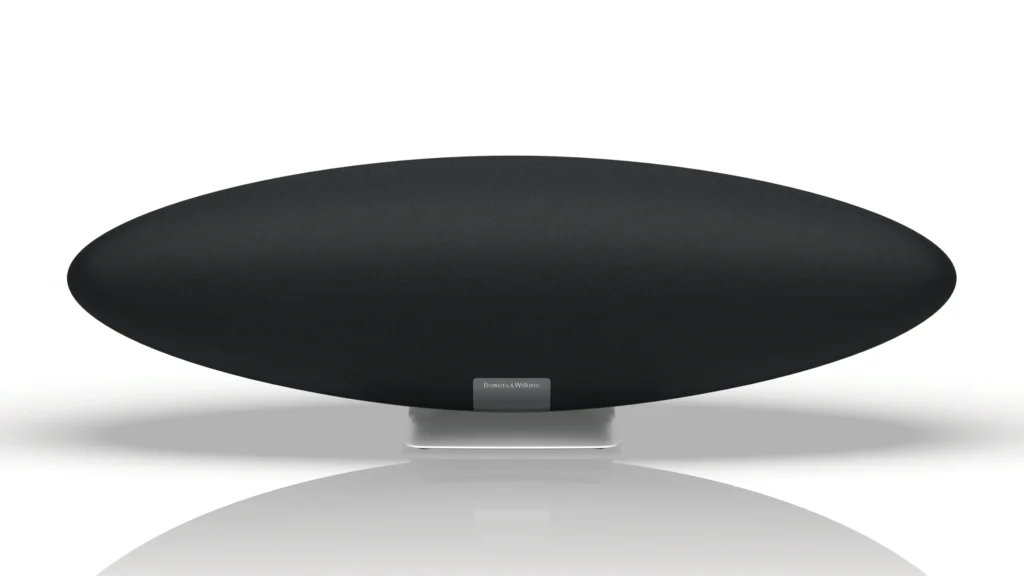
Bowers & Wilkins Zeppelin Pro Edition keeps the familiar wide, sculpted silhouette while updating the driver arrangement for a music-focused home system. Network services, AirPlay 2, Spotify Connect and Bluetooth provide its source routes. There is no ordinary analogue input, optical connection or HDMI audio, and the USB-C socket should not be mistaken for a computer DAC input. Original evaluation favours the Pro’s scale, clarity and weight over the 2021 model. Its premium appeal is strongest when the wireless platform and deliberate one-box format already fit the listening routine.
Research-based review. This assessment draws on manufacturer documentation and the original published evaluations linked below. Audio Review has not performed a hands-on test of this model.
The original listening case favours authority and clarity
What Hi-Fi’s original evaluation finds a fuller, clearer and more authoritative presentation than the 2021 comparison model, with a broad spread of sound and convincing texture on quieter music. It also finds the Naim Mu-so Qb 2 comparison more rhythmically eager on demanding material. That gives a useful balance of strengths and a specific limitation rather than an assumption that the newest version wins every comparison.
Audition with the library actually used at home. Include a familiar voice, a busy rhythmic track and a quieter recording at normal household levels. Check whether the presentation remains involving without relying on sheer loudness or bass weight. A single enclosure may be particularly attractive where two speakers cannot be positioned well, but it should still justify its premium price on musical enjoyment. The original evidence supports a serious shortlist. It does not replace checking how the system sounds on the intended furniture, or whether another complete system better matches the listener’s preference for rhythm, image placement and scale.
The driver update should not obscure the physical format
The Pro Edition uses two titanium-dome tweeters, two FST midrange drivers and a central bass unit. These are arranged within one wide enclosure. The architecture gives Bowers & Wilkins substantial control over the complete system, but the speaker remains physically different from two cabinets spaced around a listening position.
Compare those formats honestly during an audition. Sit at the intended distance and assess whether the sound feels appropriately connected to the room. Move to another seat if several people will listen, rather than judging only from one carefully selected central point. A large one-box system can be a satisfying compromise between a small smart speaker and conventional separates. Its success does not depend on claiming that all three provide the same spatial result. Someone prioritising precise stereo placement at a dedicated seat should hear a suitable pair as well. Someone who wants music to be easy to access in a shared room may reasonably prefer one carefully placed enclosure. The best choice follows the use case rather than the number or material of the drivers alone.
The wide cabinet needs a suitable support
The official technical sheet gives a width of 650 mm and weight around 6.6 kg. The sculpted shape can make it look less substantial in photographs than it is on a shelf. The manual also warns that placement close to boundaries can emphasise bass.
Measure the available surface and leave room for the mains connection and ordinary access. Use furniture that is stable and does not obviously resonate with the speaker. Avoid choosing a narrow recess solely because the cabinet looks symmetrical inside it. Listen to bass at the actual seat before deciding whether a tone adjustment or another location is preferable. If wall mounting is considered, use the appropriate documented hardware and assess the structure rather than improvising a bracket. The downward lighting may contribute to the room’s appearance, but it should not dictate an acoustically poor position. A premium music object works best when its placement lets the design and sound both make sense. One good location is more useful than an impressive appearance in a space that makes control or listening awkward.
Confirm the exact streaming route and account
The documented platform includes the Bowers & Wilkins Music app, AirPlay 2 and Spotify Connect. Bluetooth supports aptX Adaptive, AAC and SBC according to the sending device. These are different routes, with different control and format behaviour; a service name does not imply every method supplies the same stream.
Use the intended phone or tablet to demonstrate album selection, ordinary volume control and return from standby. Check the actual subscription and country rather than relying on a launch-era screenshot of available services. If Apple Music is central, establish its supported route explicitly instead of assuming it appears inside every manufacturer application. If a local library is important, test the actual playback arrangement. A maximum format claim is less important than reliable access to the music most often played. Bluetooth can be convenient for a guest, while a network route may suit regular household listening. The practical advantage is a repeatable routine that works with the existing devices. It should be established before paying for an ecosystem that requires a different control habit than the owner wants.
Sparse physical inputs deliberately narrow the role
There is no HDMI, optical or analogue audio input. The USB-C connection is not a conventional computer audio input, although the official manual documents a suitable adapter route for wired networking. This is a music-streaming system rather than a universal source hub.
Do not buy it expecting a simple cable connection from a television, conventional disc player or phono stage. The fact that one source offers Bluetooth does not guarantee a satisfactory video-synchronisation routine or replace a documented television connection. Likewise, a USB adapter cannot be assumed to turn the service socket into a DAC. If several physical sources are already owned, compare a system with the corresponding inputs before attempting workarounds. The Zeppelin can make an excellent practical case where nearly all listening comes from its supported wireless routes. It becomes less persuasive when the owner needs to replace otherwise useful source equipment to accommodate it. Clear boundaries improve the buying decision: the product’s premium styling and driver arrangement do not make missing sockets irrelevant.
App control, grouping and generation need care
The app provides source configuration, tone adjustment and downward-light settings. Multiroom use is a different task from turning two speakers into a conventional left/right pair. The exact supported arrangement should be checked in the current app and instructions before buying additional equipment.
Begin with one working system and establish the daily routine. If expansion is planned, identify compatible devices, source restrictions and how level is managed in each room. Do not transfer features from the 2021 Zeppelin or another Bowers & Wilkins product merely because the family name is shared. Current manufacturer documents and original Pro Edition evaluations should guide the comparison. Check local warranty and included accessories, especially for older stock or imported offers. Finally compare the complete price with a proper active pair and with other premium one-box systems. Zeppelin Pro Edition is strongest when its design, musical presentation and existing streaming platform all serve the actual room. Its value should not depend on an unverified future input or a grouping function that has not been demonstrated.
Alternatives to consider
Audio Pro C20 W: Compare this one-enclosure connected system if physical source flexibility is important. Assess the actual connections and television routine rather than assuming every wireless speaker can serve the same equipment.
KEF LS50 Wireless II: A properly placed active pair is a useful alternative for a dedicated stereo seat. Include stands, room space and the full source arrangement in the comparison with a premium single enclosure.
Bowers & Wilkins Zeppelin Pro Edition key specifications
- Generation
- Zeppelin Pro Edition, not Zeppelin 2021
- Format
- Mains-powered single-enclosure active music speaker
- Drivers
- Two 25 mm titanium-dome tweeters; two 90 mm FST midrange units; one 150 mm bass driver
- Network playback
- Bowers & Wilkins Music app, AirPlay 2 and Spotify Connect
- Bluetooth
- 5.0; aptX Adaptive, AAC and SBC depending on source
- Physical audio inputs
- No analogue, optical or HDMI
- USB-C
- Service connection; not a USB audio input
- Network cable option
- Official manual documents a suitable USB-C / Ethernet adapter route
- Tone control
- App bass and treble
- Lighting
- Downward light adjustable through app
- Size
- 650 × 210 × 194 mm (W × H × D)
- Weight
- Approximately 6.6 kg
View the official Bowers & Wilkins Zeppelin Pro Edition product page
Verdict
Zeppelin Pro Edition is a persuasive premium one-box music speaker, with strong original evidence for scale, clarity and a more substantial presentation than the 2021 version. Its wide cabinet and wireless-only source plan require a deliberate match. Confirm the actual service and support arrangement before buying. Choose it for the complete streaming and listening experience, with realistic expectations about physical inputs and stereo format.
Documentation and original reviews
Bowers & Wilkins official Zeppelin Pro Edition product information · Bowers & Wilkins official European technical sheet · Bowers & Wilkins official Pro Edition manual, source and placement sections · What Hi-Fi original Zeppelin Pro Edition evaluation
Editorial record
Sources and updates
Product specifications and factual claims were checked against Official Bowers & Wilkins Zeppelin Pro Edition product page ↗. Scores and buying advice follow our category-specific editorial methodology.
- Published
- November 17, 2026
- Last updated
- November 17, 2026