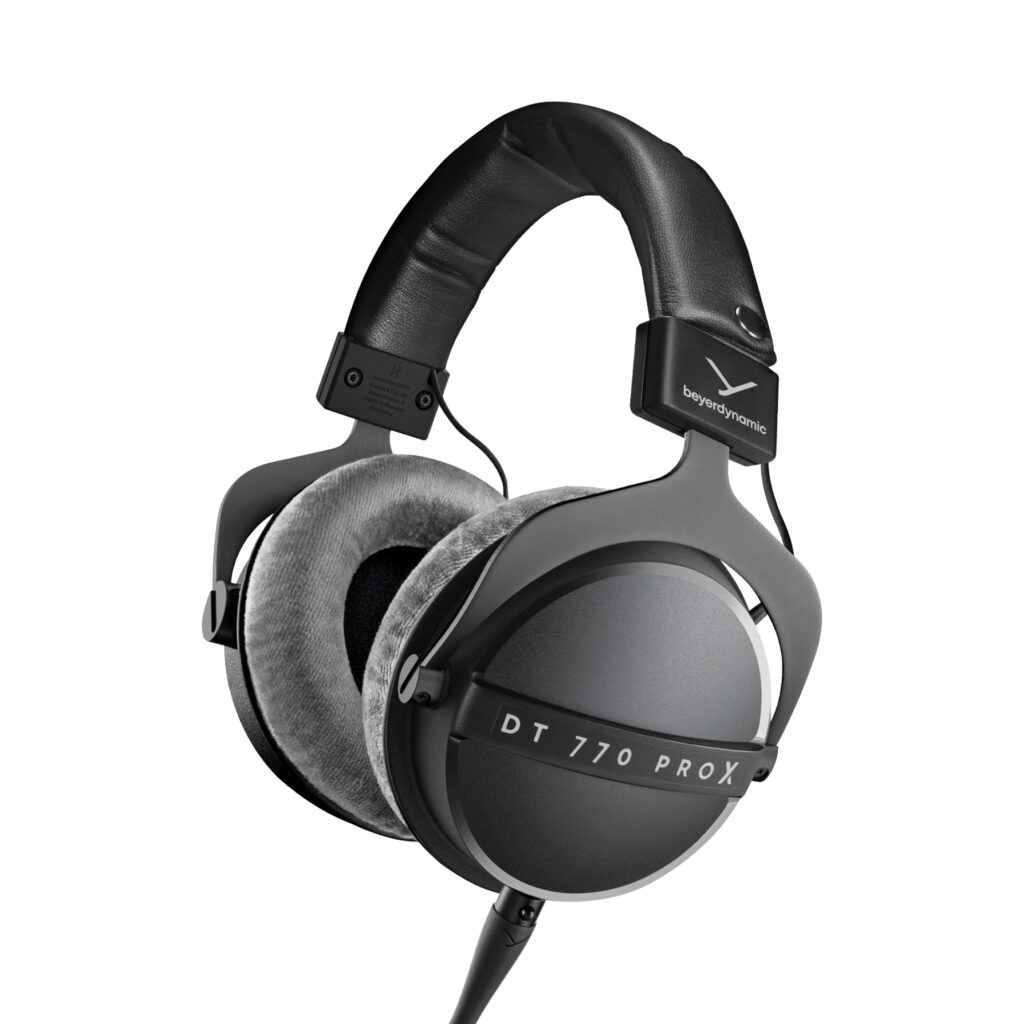
Beyerdynamic DT 770 PRO X updates a familiar closed studio formula with a 48-ohm driver and a detachable cable. This review concerns the regular model introduced in 2025, not the earlier anniversary Limited Edition and not the classic DT 770 PRO. Keeping those names separate matters: similar appearance and shared technology do not mean every published listening impression describes exactly the same tuning.
Research-based review. This assessment draws on manufacturer documentation and the original published evaluations linked below. Audio Review has not performed a hands-on test of this model.
Which DT 770 is this?
Beyerdynamic’s support note states that the standard PRO X and the Limited Edition share the same basic 48-ohm driver, but the regular version slightly reduces bass and treble compared with the anniversary model. It also has a more restrained appearance.
That distinction affects how to research a purchase. A review whose headline was updated after launch may still describe a Limited Edition listening sample. Check the version in the body and photographs rather than assuming the newest date proves a new test. On the retailer’s listing, confirm the full product name and supplied accessories before ordering. A small discount is not necessarily meaningful if it refers to a different version from the one you auditioned. The regular PRO X should be assessed on its own fit and presentation, without treating the anniversary badge as either an automatic advantage or a defect.
A controlled listening assessment
Digital Camera World’s June 2025 evaluation praises detail, control and long-session comfort while finding the presentation less overtly lively than some consumer headphones. That is useful listening context, but the manufacturer’s specifications remain the reference for physical details and connections.
For editing, start with familiar speech and listen for intelligibility at a moderate level. For music, add recordings with dense bass and prominent percussion. The important question is whether the balance lets you follow the material comfortably without compensating through volume. A description such as accurate is not a guarantee that the headphone matches every listener’s preferred target or every monitoring system. Use additional playback checks for consequential mix decisions, and consider whether you want an analytical working tool, a relaxed music headphone or one device to cover both roles.
The cable change is more than cosmetic
A removable three-metre cable locks into the left cup, and its source end is a headphone plug with a larger adapter. This makes cable replacement more straightforward than with the classic fixed-lead arrangement.
At a compact desk, three metres may be more cable than required. Plan where the spare length will sit so it does not catch a chair wheel or create a pull across the keyboard. If a shorter compatible lead is desirable, include that cost rather than assuming it is part of the standard package. The mini XLR connector belongs at the headphone cup; it does not turn the headphone into a microphone or provide a universal connection to every wireless beltpack. Compatibility starts with the source’s actual headphone output and the correct wiring, not the shape of one connector.
Closed construction and realistic isolation
This is a passive closed-back headphone. There is no electronic noise-cancelling mode or battery to keep charged, and there is no integrated microphone for calls.
Test isolation in the environment that matters. At a home desk, household conversation may be the main distraction. During recording, the priority may instead be keeping playback out of a nearby microphone. Those situations call for different checks and monitoring levels. Do not assume a closed cup blocks every sound equally, and do not compensate for a loud room simply by turning the headphone up. If the main requirement is reducing travel noise, include an appropriate ANC alternative in the audition. If calls are part of the working day, budget and position a separate microphone rather than discovering that the headphone alone cannot complete the communication setup.
Comfort and parts over a longer ownership period
The official specification gives a weight of 305 grams without the cable, velour pads and a padded headband with a central recess. Replaceable wearing parts are a practical strength, but they do not remove the need to check fit.
Try a normal working session rather than a momentary fit in a shop. Adjust the headband and note pressure at the crown, contact around the ears and stability when looking down. Glasses can change both comfort and the seal. If buying used, inspect cushion condition and obtain the price of suitable replacements before negotiating. A well-priced older pair may become less economical when several wearing parts need attention. Equally, a model that fits well and remains serviceable can be more useful than a newer alternative chosen mainly for its launch date.
Source and purchase decisions
The single 48-ohm version removes one of the classic DT 770 buying complications, but impedance alone cannot certify every phone adapter or interface. Begin with the intended source and check clean volume headroom on actual recordings.
For content creation, check the entire signal path as well as the headphone. A software monitoring delay originates upstream, and a different passive headphone will not correct it. For ordinary listening, avoid buying extra amplification before establishing a source limitation. Compare candidates at similar perceived level, include any required adapter and choose a return policy that allows a meaningful comfort assessment. The PRO X is most compelling when its simple wired role is exactly what is wanted. Paying for it while still needing a separate wireless travel headphone can be reasonable, but that should be a conscious system choice rather than an overlooked requirement.
Alternatives to consider
Beyerdynamic DT 770 PRO: The older DT 770 PRO can be an economical alternative. Compare the exact impedance and condition, and include the practical difference between a fixed lead and the PRO X detachable arrangement.
Audio-Technica ATH-M50x: ATH-M50x offers a different closed studio approach. Compare comfort, sound balance and cable handling with the same source, rather than choosing solely by the professional description.
Beyerdynamic DT 770 PRO X key specifications
- Version
- Standard DT 770 PRO X, introduced 2025
- Design
- Closed-back over-ear
- Driver
- STELLAR.45 dynamic
- Nominal impedance
- 48 ohms
- Weight without cable
- 305 g
- Supplied cable
- Detachable 3 m
- Cup connector
- Locking mini XLR
- Source connection
- 3.5 mm with 6.3 mm adapter
- Pads
- Replaceable velour
- Microphone / ANC / Bluetooth
- None
Verdict
The standard DT 770 PRO X is an appealing practical update for recording, editing and wired listening. Detachable cabling and replaceable wearing parts strengthen its case, while the published 2025 evaluation supports a careful audition for controlled detail and comfort.
Keep the regular model, Limited Edition and classic impedance variants separate when comparing reviews and offers. The right purchase is the version whose presentation, fit and complete connection cost work for the intended setup. It should earn its place through that combination, rather than through the long-standing reputation of the 770 name alone.
Documentation and original reviews
Beyerdynamic official standard DT 770 PRO X specifications · Beyerdynamic explanation of standard versus Limited Edition tuning · Digital Camera World June 2025 DT 770 PRO X listening evaluation
Editorial record
Sources and updates
Product specifications and factual claims were checked against Official Beyerdynamic DT 770 PRO X product page ↗. Scores and buying advice follow our category-specific editorial methodology.
- Published
- November 17, 2026
- Last updated
- November 17, 2026