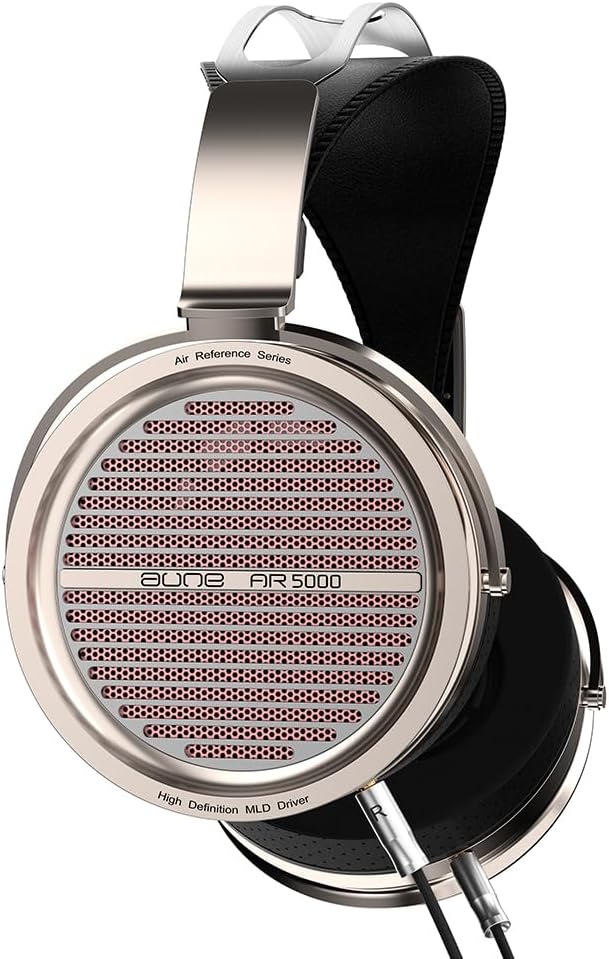
The Aune AR5000 is an unusually complete-looking entry into open-back headphones from a company better known for audio electronics. Its attraction is the combination of a carefully developed physical design, an accessible electrical load and a broadly balanced musical proposition. It deserves consideration alongside established mid-priced headphones, particularly when comfort and a simple source setup are priorities.
Aune AR5000 — Design and construction
The AR5000 is a passive open-back dynamic headphone. The large angled driver arrangement and distinctive circular framework give it a visual identity of its own. Neither the driver angle nor the decorative structure should be taken as proof of superior imaging by themselves; their value is determined by the behaviour of the complete headphone on a real listener.
Pragmatic Audio’s original evaluation reports a mixture of metal and plastic construction, a 350 g weight and detachable dual 3.5 mm earcup connections. Its published specification table gives 28-ohm impedance and 108 dB sensitivity at 1 kHz for one volt. Those conditions matter when comparing sensitivity figures with headphones specified per milliwatt.
This review concerns the original AR5000. A listing for a later revision or similarly named model should be checked separately rather than assumed to share the same tuning, accessories or measurements. Exact model identification is especially important when comparing old reviews against current shop stock.
Comfort and daily use
Pragmatic Audio praises the AR5000’s fit, weight distribution and overall construction, while identifying the stock cable’s tendency to tangle as a minor weakness. Its account also points out that the pads are specific to the model. Those are useful ownership details because comfort and replaceable wear parts can matter more over time than the appearance of the packaging.
The AR5000 should be assessed for where its headband places pressure and how its earcups settle around the jaw. Spend time with the same glasses, hairstyle and chair that you normally use for music. A brief trial in a shop may not reveal a developing pressure point or a tendency to slide when looking down at a keyboard.
An open headphone can feel less enclosed than a sealed design, but it does not automatically stay cool in every room. Pad material, ambient temperature and the listener’s own sensitivity remain relevant. If long work sessions are the main use, fit should carry as much weight as a small theoretical sound-quality advantage.
The detachable cable is a practical benefit, especially for a headphone expected to remain in service for years. Route it so that neither earcup receives a sideways pull. A more flexible replacement might improve handling, but it makes sense to live with the stock arrangement before adding accessories.
Sound quality and balance
The original Pragmatic Audio review describes a balanced presentation with controlled bass, a clear midrange and generally smooth treble. It also identifies room for more sub-bass according to preference. This is evidence in favour of the AR5000 as an all-round home headphone, while leaving the usual questions of individual fit and tonal taste unresolved.
For the prospective buyer, the first useful comparison is vocal balance. A familiar spoken voice and an intimate singer recording can reveal whether the midrange sounds natural or too prominent. Follow that with a dense arrangement to see whether the same balance stays comfortable when several instruments compete for attention.
Bass should be evaluated for both its level and its relationship to the rest of the music. Someone accustomed to heavily boosted portable headphones may want more low-frequency emphasis than a relatively restrained open design supplies. That does not necessarily indicate missing detail; it may simply reflect a different target balance.
The spacious impression associated with open headphones is not a fixed measurement of a miniature room around the head. It varies with recording techniques, ear geometry and expectations. Judge whether instrument positions are useful and convincing on familiar material rather than assuming that the widest apparent stage is always the most accurate.
For treble, include a recording with bright percussion or closely recorded strings. A smooth demonstration track cannot establish whether a headphone remains comfortable with the rest of a collection. The AR5000’s positive published balance assessment makes it worth auditioning; it does not eliminate the need to listen for the particular upper-range features that trouble you.
Amplification and connections
The published impedance and sensitivity figures suggest that the AR5000 can be used with a competent compact source without an unusually powerful amplifier. Pragmatic Audio reports successful use from both portable and desktop outputs. That is an encouraging practical reference, not a guarantee that every phone adapter or computer socket will perform identically.
Try the source already available before creating a large equipment budget. Listen for hiss, insufficient level on quiet recordings and awkward volume adjustment. If those problems are absent, a more expensive amplifier should have a specific purpose, such as additional inputs, a physical control or convenient switching to speakers.
A USB DAC is useful when the computer or phone lacks an analogue connection. Check the connector and operating-system support rather than buying from a headline sample-rate figure. Reliable playback, appropriate gain and comfortable volume control have a direct effect on daily use. Extreme digital-format capability may have no relevance to the music library.
Balanced cabling is an optional system choice, not an intrinsic requirement of the AR5000. Use a correctly wired cable designed for the intended output, and do not improvise adapters between incompatible amplifier arrangements. A clean single-ended output with enough reserve is a perfectly sensible starting point.
Limitations and value
The open design offers little separation from the surroundings and allows music to leak. This is a home-listening product for a reasonably quiet space. It is less appropriate beside a sensitive recording microphone, in a shared office or anywhere that requires keeping the music private. Those are environmental limitations rather than problems solved by better electronics.
A separate microphone is needed for calls or gaming communication. Check whether leakage reaches it at the actual listening volume. If background noise is the reason for seeking a new headphone, a closed model or active noise-cancelling design is a more relevant category to investigate.
For European buyers, pad availability and authorised support deserve a direct check with the seller. An unfamiliar brand is not a reason to reject a product, but it makes the local service route more important. Ask which replacement parts can be supplied and how returns are handled if the fit proves unsuitable.
The value case is strongest when the AR5000 works comfortably from a source already owned and its stock balance suits the listener. It becomes weaker if the purchase immediately requires several accessories to address basic fit or tonal dissatisfaction. Compare the complete usable system against established alternatives rather than judging only the headphone’s advertised price.
The AR5000’s appeal is its balance of qualities: an individual design, encouraging independent sound reports and practical electrical requirements. That combination is more persuasive than any single technology claim. It should be treated as a serious audition candidate rather than either a guaranteed bargain or a speculative purchase based on appearance.
Alternatives to consider
Sennheiser HD 600: An established open dynamic reference, particularly useful for comparing vocal presentation and the demands placed on the source.
HiFiMAN Sundara: A planar alternative with a different fit and electrical proposition; audition the complete experience rather than choosing by driver category.
Beyerdynamic DT 900 Pro X: A practical studio-oriented open option for buyers who want to compare support, monitoring use and long-session fit.
Aune AR5000 key specifications
- Design
- Open-back dynamic
- Impedance
- 28 ohms; published specification
- Sensitivity
- 108 dB at 1 kHz / 1 V; published specification
- Weight
- 350 g; published specification
- Cable
- Detachable dual 3.5 mm earcup connections
- Model
- Original AR5000; not a later revision
- Driver
- 50 mm MLD dynamic
Verdict
The Aune AR5000 is a well-rounded open dynamic headphone with encouraging independent evidence for sound, comfort and value. It makes particular sense for a quiet home setup that should work without elaborate amplification. Confirm the fit and replacement-pad route, then judge its stock balance against established alternatives before buying.
Primary documentation and independent reviews
Aune AR5000 official product page · Pragmatic Audio original review and measurements · Headphones.com original AR5000 review
Editorial record
Sources and updates
Product specifications and factual claims were checked against Official Aune AR5000 product page ↗. Scores and buying advice follow our category-specific editorial methodology.
- Published
- November 7, 2026
- Last updated
- November 17, 2026