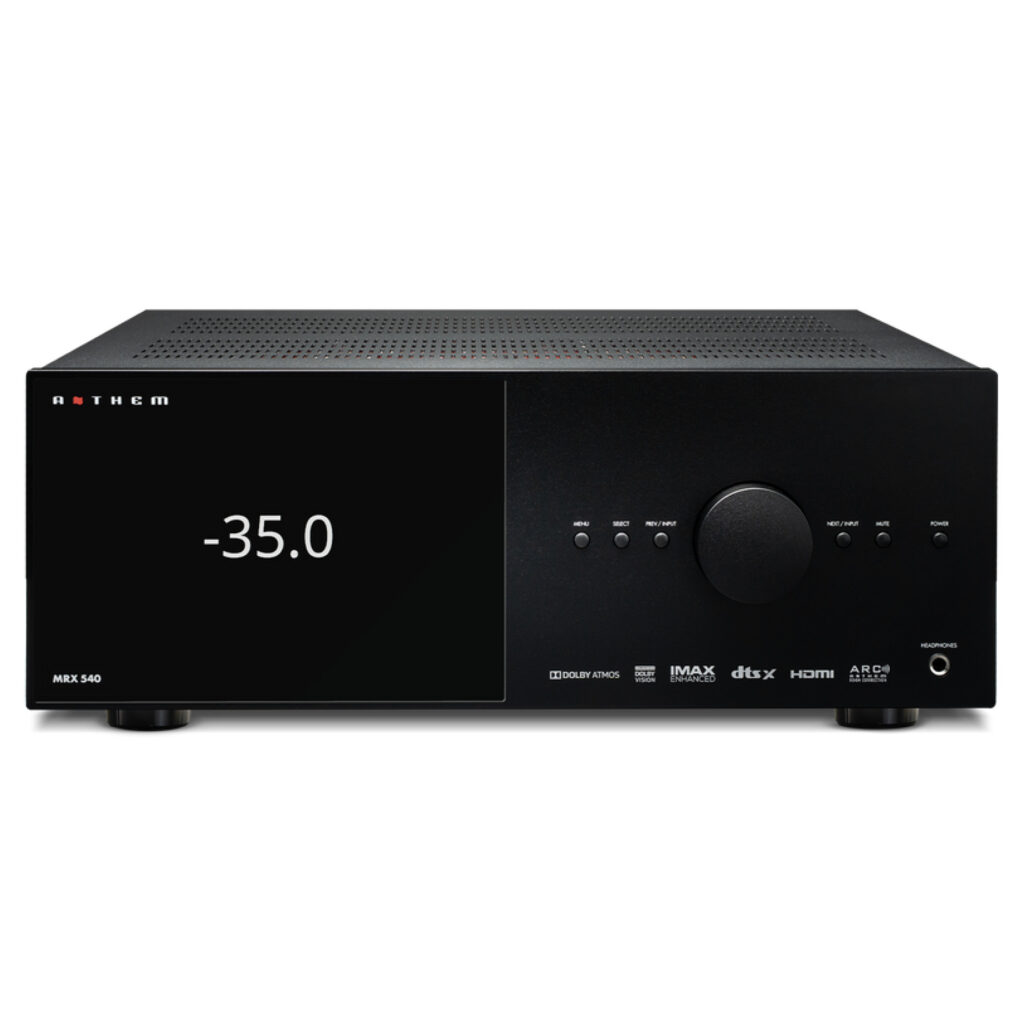
The Anthem MRX 540 8K takes a deliberately different approach from receivers that compete mainly on amplified channel count. It supplies five internal power channels, seven-channel processing and ARC Genesis calibration, with current 8K-capable HDMI hardware. Its strongest case is a carefully configured modest cinema, or a system using existing external amplification, rather than the largest speaker layout for the purchase price.
Anthem MRX 540 8K — Design and everyday operation
The clean front display and restrained controls give the MRX 540 8K a more contemporary appearance than a receiver covered in source buttons. Much of the detailed setup is handled through Anthem’s web interface. That suits a permanent installation, where inputs can be named around real activities rather than memorised socket numbers. A household is better served by an understandable film or music selection than by an unexplained list of technical input labels.
Plan access to the receiver and its network connection before putting it in furniture. The web interface is useful only when the controlling device can reliably reach the unit. Wired Ethernet is sensible where practical, especially in a rack containing several networked components. Leave space for cable bends and heat to escape. A visually tidy closed cabinet can be a poor home for an amplifier, particularly during a long film at an enthusiastic playback level.
Five amplifiers and the seven-channel ceiling
Five internal amplifier channels naturally suit a conventional 5.1 or 5.2 system. Seven-channel processing and pre-outs allow a larger layout with external amplification, including 5.2.2 Atmos or seven floor-level speakers. The external amplifier is an additional requirement, not a hidden capability of the five internal channels. Work from the manual’s assignments when deciding which speakers it will drive. Do not assume the free reassignment facilities of a larger Anthem model apply here.
This architecture makes sense when the buyer already owns suitable amplification or deliberately wants to prioritise a high-quality five-speaker installation. It is less attractive if two height speakers are an immediate requirement and the extra amplifier must be purchased from scratch. Add the cables, shelf space and switching behaviour to that calculation. A receiver with more internal amplifiers may create a simpler complete system even if its initial price is higher.
Seven processed main channels are also a firm planning boundary. No external amplifier adds the processing required for four height speakers alongside a five-channel bed. Buyers committed to that arrangement should move to a larger model before running cables. The MRX 540 8K is a focused choice, and its value depends on accepting that focus rather than treating it as the first stage of unlimited expansion.
ARC Genesis as the central attraction
ARC Genesis is a major reason to consider the Anthem. The package is intended to help integrate the loudspeakers with the listening room, using measurements and adjustable targets rather than relying only on the speaker’s published response. Its value is most obvious when a system has good basic placement but needs help with room-related bass emphasis and consistency. It cannot remove every consequence of an awkward room or a blocked centre speaker.
Set up the physical system first, then follow the current ARC instructions with the correct microphone calibration information. Keep the microphone stable, avoid background noise and save the project. A saved measurement set is valuable when comparing targets or restoring the system after an experiment. Work towards the actual seating area rather than measuring places nobody uses. A single listener and a broad family sofa may justify different optimisation priorities.
Do not assume advice from an early review describes every current software behaviour. Firmware and ARC releases have developed since this receiver family launched. Use the current instructions for distance, phase and profile management, and inspect the resulting configuration before serious listening. If the calibrated sound is unsatisfying, compare target choices and bass-management settings at matched volume before blaming the receiver’s amplifier section. The goal is a convincing result in the room, not simply a completed progress bar.
Published sound evidence and its limits
Sound+Image’s original MRX 540 review, also published by What Hi-Fi, praised the earlier receiver’s surround presentation and the improvements from ARC, while noting fan noise on its sample. That test covered the original 4K hardware, not a direct test of this 8K version. It is useful context for the family and setup approach, but its findings should not be presented as fresh measurements or listening observations of the current model.
The official 8K support specification lists 100 watts into eight ohms across 20 Hz to 20 kHz at one percent distortion with two channels driven. Those conditions should accompany the number. It is not an all-five-channels continuous-output claim, and it cannot be compared directly with a competitor’s rating made at a different distortion threshold or load. The relevant question remains whether the intended loudspeakers can reach the required level cleanly at the seating distance.
For a focused cinema, preserve budget for an appropriate centre speaker and active subwoofer. Clear dialogue and controlled bass are more valuable than buying a premium receiver and compromising every other component. The pre-outs also allow existing front-channel amplification to remain useful. If doing so, check gain and turn-on behaviour, then calibrate the assembled system rather than assuming old level settings will transfer unchanged.
8K HDMI and source matching
The 8K designation matters. Earlier MRX 540 units were supplied with a different HDMI board, so a second-hand listing must identify the actual hardware rather than relying on the family name. Current 8K documentation includes 4K/120 and 8K/60 pass-through and contemporary gaming facilities. Confirm the specific source, display mode and cable run in the finished chain instead of treating the HDMI label as a guarantee for every possible combination.
Returning television audio through eARC can simplify some installations, but the television must pass the desired audio format. Test ordinary television apps as well as an external console or disc player. An arrangement that works with stereo streaming does not automatically establish lossless multichannel compatibility. A practical handover should demonstrate the actual sources used by the household, including input switching and recovery after standby.
The receiver provides familiar network playback routes including AirPlay 2 and Chromecast, but that is a different proposition from choosing it for a comprehensive proprietary music-library application. Try the preferred phone and service before adding a separate streamer. Vinyl users should budget for a suitable phono stage or a turntable with one built in; a line-level analogue connection does not replace the gain and equalisation required by a cartridge.
Value and the right buyer
The MRX 540 8K is strongest for someone who has deliberately chosen a modest speaker layout and values Anthem’s setup approach. It can also make sense as a route to current HDMI switching while retaining good external power amplification. Its premium is harder to justify when the immediate goal requires more powered speakers and the rest of the system must be built on a strict budget.
Compare complete European system prices, local warranty and calibration support. Include any external amplifier needed for Atmos and audition the exact unit’s operational noise in a quiet room where possible. A noise observation from one old review is not proof that every current unit behaves identically, but quiet mechanical operation is a reasonable acceptance check. The Anthem should be selected for a particular system plan, with its channel ceiling fully understood.
Alternatives to consider
Anthem MRX 740 8K: The logical comparison when more internal amplification and a larger processing layout are needed.
Denon AVC-X3800H: Compare if powered channel count and subwoofer flexibility matter more than the Anthem calibration workflow.
Anthem MRX 540 8K key specifications
- Amplified / processed main channels
- 5 / 7
- Pre-outs
- 7.2
- Rated power
- 100 W/ch, 8 ohms, 20 Hz–20 kHz, 1% THD, 2 channels driven
- Calibration
- ARC Genesis
- Video
- 8K/60 and 4K/120 pass-through; verify exact chain
- Phono
- External stage required
Verdict
The Anthem MRX 540 8K is an appealing specialist receiver for a focused five-channel system, especially when ARC Genesis and existing external amplification fit the plan. It is an expensive route to a larger Atmos layout, and its seven-channel processing limit should be accepted before purchase.
Primary documentation and independent reviews
Anthem MRX 540 8K official information · Anthem model-specific power specifications · Anthem 8K series documentation · Sound+Image original MRX 540 review; earlier 4K version
Editorial record
Sources and updates
Product specifications and factual claims were checked against Official Anthem MRX 540 8K product page ↗. Scores and buying advice follow our category-specific editorial methodology.
- Published
- November 7, 2026
- Last updated
- November 8, 2026