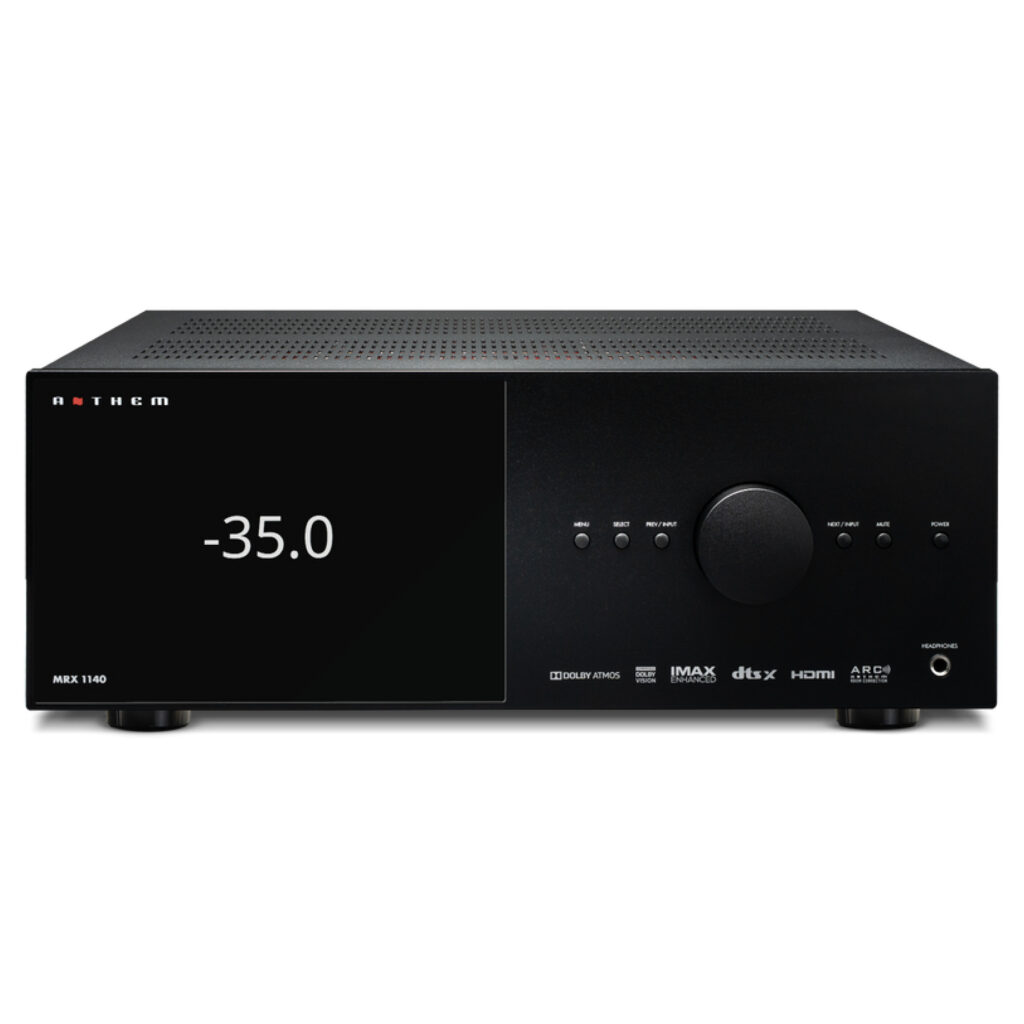
The Anthem MRX 1140 8K combines eleven internal amplifiers with processing for a much larger 15.2-channel system. It can run a complete 7.2.4 cinema by itself and support more ambitious layouts with external amplification. ARC Genesis and flexible configuration make it a serious installation platform, provided the buyer understands that its amplifier channels do not all share the same output rating.
Anthem MRX 1140 8K — Design for a permanent cinema
The MRX 1140 8K has a clear visual identity: a clean front panel with a prominent display, supported by detailed web-based configuration. It feels most logical as the centre of a planned cinema rather than a component selected casually to add a few inputs. Its flexibility is useful when source names, speaker profiles and everyday operation are organised around the room. A carefully labelled interface helps the owner use that flexibility without learning an installer’s terminology.
Before purchase, confirm rack depth, rear cable clearance and ventilation. A large receiver can fit on paper yet become difficult to service once multiple HDMI leads and pre-out cables are connected. Leave a way to reach the rear panel and keep a record of the finished wiring. If an installer configures the system, ask for saved settings and a short handover that covers ordinary use, standby behaviour and recovery after a source or display has been disconnected.
Eleven powered channels with greater processing capacity
The distinction between eleven amplifiers and 15.2 processing is the core of this receiver’s appeal. An eleven-speaker arrangement can be powered internally, while larger layouts require additional power amplifiers. That makes the MRX 1140 8K a credible staged platform for a room whose final speaker positions have already been planned. It does not mean that every expansion is achieved by simply adding speakers to spare terminals.
Work through channel assignments before buying the external amplifier. The number of channels, amplifier gain and the role of existing internal channels all matter. A seemingly inexpensive amplifier can create extra complexity if it lacks a convenient trigger or has unsuitable input sensitivity. The receiver’s processing can be valuable even when some internal power channels are unused, particularly where demanding front speakers already have suitable external amplification.
Two independent subwoofer channels are another meaningful part of the specification. They allow a more deliberate two-subwoofer setup than a pair of sockets carrying an identical managed signal. Even so, independence does not guarantee uniform bass at every seat. Subwoofer positions, room modes and the measurement area still determine what correction has to work with. A large cinema benefits from considering the bass layout as a system rather than treating two subwoofers as an accessory purchased after everything else.
Understanding the amplifier split
Anthem’s official support table distinguishes the first five power channels from the remaining six. With two channels driven into eight ohms across 20 Hz to 20 kHz at one percent distortion, the figures are 140 watts and 60 watts respectively. A listing that describes the receiver simply as eleven times 140 watts hides a practical distinction. The lower-powered channels can be appropriate for less demanding roles, but they should not be assumed identical to the main group.
That distinction matters when assigning power to different speakers or considering passive bi-amplification. More connected terminals do not automatically provide the best use of the available amplifier sections. Follow the current assignment guidance and choose external amplification around the speakers that need it. Loudspeaker sensitivity and distance may make a modest rating entirely adequate for a height channel while a demanding front speaker requires more headroom.
Audioholics’ original bench work on the earlier MRX 1140 praised its preamplifier performance and examined the practical consequences of the different internal amplifier sections. That test used the original generation’s hardware before the current 8K version. It is useful background for the architecture, but its exact measured results should not be claimed as a new bench test of an 8K production unit. This assessment therefore combines that context with the current official specifications rather than transferring every old number unchanged.
ARC Genesis and sound expectations
ARC Genesis is central to the Anthem proposition. In a large speaker system, calibration must establish a coherent whole rather than merely produce impressive individual channel responses. Correct placement, sensible crossovers and a well-defined seating area should come before filter adjustment. A receiver with sophisticated correction can refine a good installation; it cannot make badly positioned speakers behave as though they occupy ideal positions.
Save the measurement project and the finished settings. This makes later comparison more meaningful and avoids starting again after an experiment. If the room has several regular listeners, measure an area that represents them rather than a single point chosen because it produces the prettiest graph. Keep the calibration environment quiet and check any surprising detected result. A loose cable or muted speaker should be solved physically instead of being accepted as an unusual acoustic characteristic.
The expected benefit is more consistent tonal integration, clearer dialogue and better-behaved bass in the actual room. Those are system goals, not listening claims from an Audio Review test. Audition a calibrated installation with familiar material and the intended playback level. The MRX 1140 8K’s processing flexibility is compelling, but a good centre speaker, suitable subwoofers and room work remain essential parts of the purchase rather than optional luxuries after the receiver has consumed the budget.
8K video and everyday sources
Choose the actual 8K hardware version when current high-refresh video is a requirement. Earlier MRX 1140 units were sold with different HDMI hardware, so used-stock descriptions and upgrade history need checking. Anthem’s current 8K documentation specifies 4K/120 and 8K/60 pass-through. Confirm the desired format across the receiver, television or projector, source and cable run before considering the installation complete.
The main and zone paths should be planned separately. A second display can introduce a different set of resolution and handshake requirements, and a successful test on one screen does not establish the behaviour of every combined output arrangement. Test input switching, standby recovery and television audio return with the equipment that will actually remain in the room. Reliability in those ordinary operations matters more than a long list of formats that are never used.
Network playback routes such as AirPlay 2 and Chromecast can cover everyday music without immediately adding a separate streamer. Try the preferred service and control device first. A dedicated source may still be justified by a particular library workflow, but it should solve a real problem. Vinyl needs an appropriate phono stage, because analogue line inputs alone do not provide cartridge-level gain and equalisation.
Value and alternatives
The MRX 1140 8K makes the strongest case for a buyer who needs its processing capacity and values Anthem’s calibration and configuration approach. The ability to grow beyond eleven main speakers can preserve the investment in the receiver while amplification develops. If the room will permanently stop at a modest layout, the additional capability may never repay its cost. More available channels do not improve a speaker that cannot be placed sensibly.
Compare the whole European installation budget, including external amplifiers, calibration and any rack work. Check operational noise on the exact unit in a quiet environment where possible, since a receiver can be electrically capable yet inconvenient beside a nearby seat. Local support and a clear plan for firmware and settings are valuable. This is a receiver to select after designing the cinema, not a substitute for that design.
Alternatives to consider
Anthem MRX 740 8K: Consider if the final speaker count fits the smaller processing platform and external amplification is acceptable.
Denon AVC-X3800H: A useful lower-cost comparison for systems that do not require the Anthem’s larger processing ceiling.
Anthem MRX 1140 8K key specifications
- Amplified / processed main channels
- 11 / 15
- Pre-outs
- 15.2
- Power: first 5 channels
- 140 W/ch, 8 ohms, 20 Hz–20 kHz, 1% THD, 2 channels driven
- Power: remaining channels
- 60 W/ch, same published test conditions
- Subwoofers
- 2 independent channels
- Calibration
- ARC Genesis
- Video
- 8K hardware version; 8K/60 and 4K/120 pass-through
Verdict
The Anthem MRX 1140 8K is a convincing platform for a planned large cinema, with eleven internal amplifiers, 15.2 processing and ARC Genesis. Its mixed amplifier ratings and external-amplification requirements deserve careful planning. Its premium is most justified when the larger processing layout will actually be used.
Primary documentation and independent reviews
Anthem MRX 1140 8K official information · Anthem model-specific amplifier ratings · Anthem current 8K-series documentation · Audioholics original MRX 740/1140 bench test; earlier hardware
Editorial record
Sources and updates
Product specifications and factual claims were checked against Official Anthem MRX 1140 8K product page ↗. Scores and buying advice follow our category-specific editorial methodology.
- Published
- November 7, 2026
- Last updated
- November 8, 2026